Swimming Beaches: Read Water Conditions Before You Go means checking water quality and physical hazards separately, then comparing current notices with what you see at the exact swimming area. We help beach enthusiasts find a promising shoreline, but local warnings and conditions on the day should guide the decision to enter.
Free Printable Field Reference & Checklist (PDF)
Save or print our one-stop reference sheet for this guide: Rip Current Identification Diagram, Flag Color Key, and Pre-Swim Safety Checklist. Includes the full specification comparison matrix and step-by-step field checklist.
Key Takeaways
| Question | Quick answer |
|---|---|
| Where should I start? | Use The Beach Directory to discover coastal destinations, then browse beaches listed for swimming and check current local notices before travelling. |
| How can I tell if a beach is suitable for swimming? | Check water quality notices, surf and weather conditions, tide information, and signs at the beach. A clear result or calm appearance cannot answer every safety question. |
| What should I do if notices disagree? | Follow the most cautious current warning and ask a lifeguard if one is present. Wait until you can make a clear decision. |
| What can a water quality report tell me? | It describes a sample from a particular place and time. It does not measure waves, currents, water depth, or underwater obstacles. |
| What if I spot a possible rip current? | Stay out of that area and alert a lifeguard. If caught in a rip, float, signal for help, and swim parallel to shore to leave the current. |
| When should I leave the water? | Leave if the weather, waves, wind, or warnings change, or if you feel cold, tired, or less coordinated. |
Check Current Notices for the Exact Swimming Area
Start with the swimming notice from the beach authority or local public health department. Then check the surf zone forecast and any lifeguard updates, because these cover different risks: water quality notices address contamination, while forecasts and lifeguards can report physical hazards and changing conditions.
Match a water quality report to the precise beach access or swimming area you plan to use. Read the sample location and collection date, since a nearby station or an older sample may not reflect conditions at your destination today.
A posted closure or advisory for the named area takes precedence even if the water looks clear or other people are swimming. If current notices conflict, follow the most cautious warning, ask a lifeguard if available, and wait rather than entering while the situation is uncertain.
Our beach listings help you compare destinations and features, while local swimming notices guide the decision on the day. Use both: one can help you choose a beach, and the other can tell you what is happening at the swimming area now.
Separate Water Quality from Surf and Current Hazards
Ask two separate questions before swimming: do water quality notices report contamination, and do waves, currents, weather, depth, or underwater hazards make entry dangerous? A clean water result does not establish that surf and currents are safe.
A water quality sample measures conditions at a particular place and time. It does not measure rip currents, wave force, sudden depth changes, or submerged obstacles, so check physical conditions separately.
| Condition to check | What the source measures or reports | What it cannot establish | Warning that should change your decision |
|---|---|---|---|
| Water quality | Indicator bacteria results and local contamination notices for a sampling area. | Wave force, currents, depth, or submerged obstacles. | A current advisory, closure, or contamination warning for your intended area. |
| Surf and currents | Breaking waves, current risks, wind, and hazards identified in a surf zone forecast or by lifeguards. | Whether a water quality sample reports contamination. | A rip current warning, hazardous surf, strong current, or conditions beyond your ability. |
| Weather | Local wind, storms, and changing weather that can affect visibility and water movement. | Water quality or every hazard beneath the surface. | Lightning, an approaching storm, strong offshore wind, or a sudden change in conditions. |
Monterey State Beach stretches along Monterey Bay, where its protected location creates gentler conditions than many California beaches. Its setting helps illustrate how a bay can shape surf exposure, but today’s notices and observations still determine whether swimming conditions suit you.
Do not treat clear water, calm-looking water, or other swimmers as proof of safety. Currents and underwater hazards can be difficult to see from shore.
Understand What Water Quality Results Can Tell You
Water quality grades describe bacterial test results, not the full safety of a beach. In Florida, marine water is classified as Good at 0 to 35 enterococci per 100 milliliters, Moderate at 36 to 70, and Poor at 71 or greater, according to the Florida Department of Health. These are Florida program thresholds, not a universal beach rating system.
| Florida classification | Enterococci per 100 milliliters | Practical meaning |
|---|---|---|
| Good | 0 to 35 | Falls within Florida’s Good category for marine water. |
| Moderate | 36 to 70 | Falls within Florida’s Moderate category for marine water. |
| Poor | 71 or greater | Falls within Florida’s Poor category for marine water. |
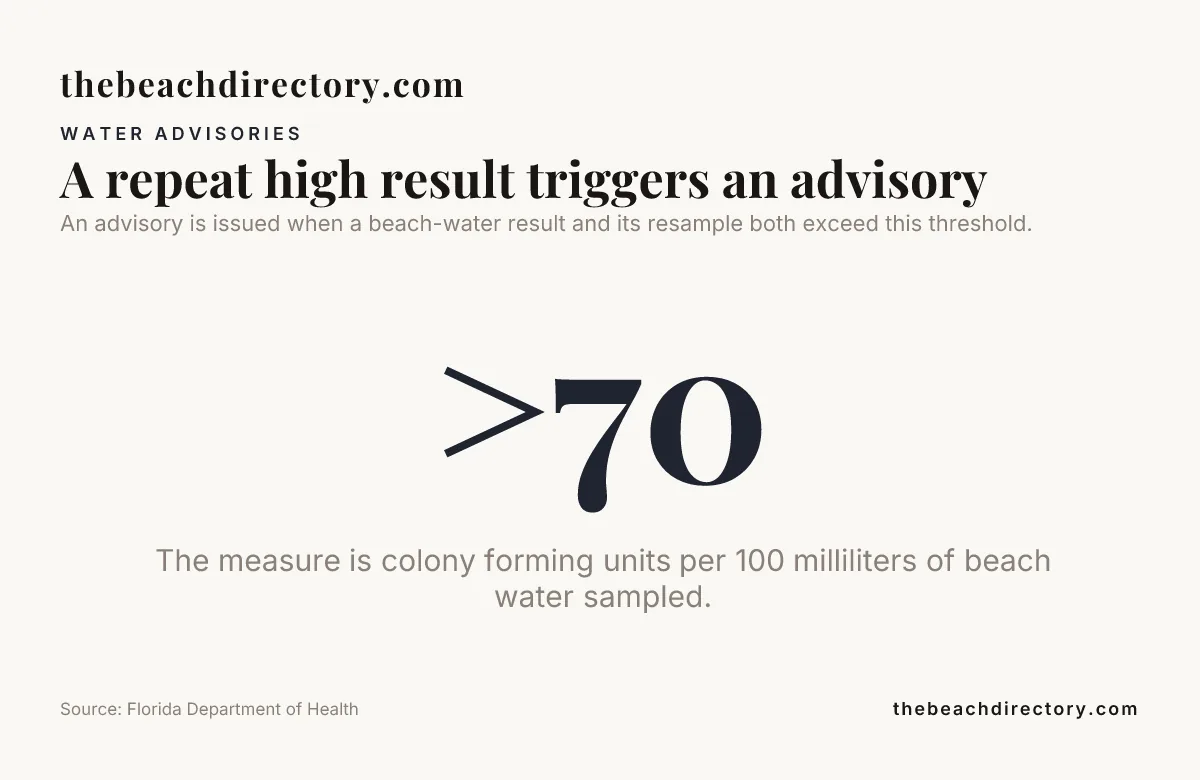
An advisory is issued when a beach-water result and its resample both exceed this threshold.
Source: Florida Department of Health
Indicator bacteria methods take time, so a result describes the sample rather than guaranteeing current conditions. After heavy rain, check local notices because stormwater runoff can carry contamination into swimming water, and follow local guidance on when conditions are suitable again.
Read Surf, Flags, and Changing Weather
Read the surf zone forecast for breaking waves, current risks, wind, and stated hazards. A strong offshore wind can carry swimmers or floating objects away from shore, while a longshore current moves parallel to the beach and can pull swimmers away from their chosen entry point.
From shore, look for a narrow channel of churning or discoloured water, a break in the line of breaking waves, or foam moving steadily offshore. These can indicate a rip current, but a rip may not be obvious, so do not rely on visual clues alone.
Beach warning flags do not have one universal meaning. Read the beach’s own signs and flag descriptions, and ask a lifeguard rather than guessing what a purple or another coloured flag means.
Recheck conditions when wind, tide, storms, or wave patterns change. There is no single time of day that is unsafe at every beach, but thunderstorms, darkness, poor visibility, or the absence of lifeguard supervision can make it harder to identify hazards and get help.
Alamitos Beach has a wide sandy shoreline protected by a breakwater that creates calm swimming conditions. It is a useful example of sheltered shoreline geography, while current surf and weather notices still matter before entering.
If your coastal plans also include surfing, our surfboard selection guide can help with board planning. Surf equipment does not replace checking swimming conditions or following local warnings.
Check Temperature, Tide, Depth, and Underwater Hazards
Check the reported water temperature and plan for the effect of cold water on breathing, strength, and coordination. Enter cautiously, and leave if shivering, numbness, or loss of coordination begins.
Consult the local tide forecast and watch how quickly the water is rising or falling. Tides can expose slippery rocks, alter access routes, and change the shape of shallow channels, so a familiar shoreline can feel different at another tide stage.
From a safe vantage point, look for rocks, reefs, piers, submerged debris, and sudden changes in depth. Avoid diving where you do not know the depth or what lies underwater.
A sheltered cove or breakwater describes local geography, not a guarantee that currents, water quality, or conditions are safe today. Use those features to understand the setting, then check the current notices and water in front of you.
Use This Step by Step Field Checklist
- Before leaving, check the exact beach. Look up its current water quality notice, swimming closure or advisory, surf forecast, weather, and tide information. Confirm that the report refers to your planned access point or swimming area.
- At the beach, read every sign and flag. Locate the lifeguard and ask about conditions if a warning or forecast is unclear.
- Observe the water from shore. Watch breaking waves, possible rip channels, wind direction, water movement, and visible hazards. Do not use other swimmers as evidence that entry is safe.
- Choose not to enter when the picture is uncertain. Stay out if an advisory applies, a warning is unclear, hazards look beyond your ability, or reports and observations do not agree.
- If conditions are suitable, swim within a safe plan. Go with a capable companion, stay within your ability and the supervised area, keep children under close adult supervision, and leave when conditions change.
- If caught in a rip current, focus on conserving energy. Stay calm, float, signal for help, and swim parallel to shore out of the current before returning diagonally. Do not fight directly against it.
Test results also have a timing limit: Woods Hole Oceanographic Institution explains that current EPA methods for detecting indicator bacteria require at least 24 hours to provide results. That delay is why a test result describes its sample rather than guaranteeing the water’s condition at the moment you arrive.
Frequently Asked Questions
Does a beach advisory mean the whole beach is closed?
An advisory about water conditions and a closure restricting access are different actions, and the notice states which one applies. A beach may remain physically open while an advisory is in effect.
How often should I recheck conditions after I enter the water?
There is no single interval that suits every beach. Keep the shoreline and warning station in view, and ask a companion on shore to alert you if flags, weather, or lifeguard instructions change.
Is it safer to swim at high tide or low tide?
Neither tide stage is universally safer because beach slope, channels, and local currents vary. At an inlet or narrow channel, moving water can matter more than whether the tide is high or low.
What should I do if I cannot identify a beach warning flag?
Stay on shore until you know what the flag means. If no lifeguard is nearby, ask beach staff or the local authority responsible for the site instead of relying on a colour guide from another beach.
What is the safest way to help someone caught in a rip current without entering the water?
Call emergency services or alert a lifeguard, then throw a flotation aid or line if one is available. Keep pointing to the swimmer so rescuers can track their position, and do not enter the current yourself.
What beaches in Florida have bacteria right now?
Current results are specific to individual sampling locations and can change as new reports are posted. Check Florida’s beach water quality information for the exact beach, sampling location, and collection date before making plans.
How to tell if a beach is safe to swim?
Check current water-quality notices for the exact swimming area, along with surf, current, weather, and tide conditions. Read local signs and flags, and stay out if there is an advisory, a hazard beyond your ability, or conflicting information.
What time of day should you not swim in the ocean?
Set a time to leave before visibility drops, and get out sooner if conditions change.
What does a purple flag mean at a beach?
Purple flag meanings vary between beaches, so the colour alone does not have a universal meaning. Read the local flag descriptions or ask a lifeguard before entering the water.
Conclusion
Swimming Beaches: Read Water Conditions Before You Go is a practical decision process: match the water quality notice to the exact swimming area, check surf and weather separately, and read local signs before entering. If warnings, forecasts, and what you observe do not agree, wait for clear guidance and choose a safer time or place for your swim.
Download the Companion Printable Reference Sheet (PDF)
Save or print our one-stop reference sheet for this guide: Rip Current Identification Diagram, Flag Color Key, and Pre-Swim Safety Checklist. Includes the full specification comparison matrix and step-by-step field checklist.