For Oregon Coast camping, book a designated campground unless the land manager explicitly permits overnight camping on the beach itself. Our guide to Oregon beach destinations can help you find coastal areas to explore, but each campground has its own reservation process, site limits, and access rules.
Key Takeaways
- Public beach access does not grant permission to camp on the sand. Choose a designated campground and follow the rules set by its land manager.
- Reservations depend on the operator and campground. Some sites take advance bookings, while others may offer first-come, first-served camping or walk-up options. Start with our directory of beaches and parks associated with camping.
- State, county, and federal campgrounds may use different booking systems. Identify the operator before you search for a campground reservation.
- Availability does not guarantee a suitable site. Match the site capacity, vehicle fit, driveway length, and facilities to your group and equipment.
- Same-day reservations and walk-ups are not guaranteed. Keep another campground in mind as a backup.
- Review alerts and access information before departure. A campground can be open while a route to the beach or a specific facility is restricted.
Free Printable Field Reference & Checklist (PDF)
Save or print our one-stop reference sheet for this guide: Oregon Coast Campground Reservation Window, Hookup, and Beach Access Comparison Sheet. Includes the full specification comparison matrix and step-by-step field checklist.
Beach camping means more than a campsite near the shore
Beach camping means sleeping on the beach only when the land manager expressly allows overnight stays there. A campground beside the ocean, or one with a trail to the shore, is different from permission to pitch a tent on the sand.
Public access to Oregon beaches does not automatically allow overnight camping. Rules can vary by beach, park, and season, so use an established campground unless its managing agency clearly identifies a beach area where overnight camping is permitted.
Plan the campsite and beach visit as two connected but separate choices. Confirm where you may sleep, then check whether the route to the beach is open and suitable for your group.
Several coastal campgrounds offer beach access without allowing overnight stays directly on the sand. South Beach State Park has year-round camping near Newport and a long, sandy beach. Beverly Beach State Park offers year-round camping in a forest setting close to the beach.
Other options include Cape Lookout State Park, with campsites, yurts, cabins, and a beach, and Harris Beach State Park, which pairs year-round camping with tidepooling and views of offshore sea stacks. At Sunset Bay State Park, campers can enjoy a protected cove, picnic areas, and connections to nearby trails.
Identify the land manager before choosing a reservation system
Start by finding out who operates the campground. A state park name points you toward Oregon State Parks, a county park toward the relevant county, and a national forest or federal recreation area toward its federal land manager. Use the official campground page or posted signs to verify the operator, then follow that manager’s booking instructions.
State, county, and federal sites do not necessarily share a reservation system or identical rules. A county campground may set its own booking window and arrival procedure, while a state park or federal campground may use a different official portal. Reservation methods vary between coastal parks.
Look for the booking calendar, current operating season, site type, and instructions for making a reservation. If the page describes first-come, first-served camping, that means sites are assigned in order of arrival rather than held through an advance reservation. The abbreviation FF commonly means first-come, first-served.
A distance rule may apply to a particular land manager or location, so use the campground’s current rules rather than relying on a general phrase.
Compare coastal camping options and practical details
Compare the setting and facilities as well as the reservation calendar. The examples below include concrete details that can help you narrow your choices, but the managing agency’s current page remains the place to verify operating information and site rules.
| Campground or area | Known setting or measurement | What to consider |
|---|---|---|
| South Beach State Park | Year-round camping, yurts, hiking and biking trails, and an interpretive center. | Check the booked site’s location, facilities, and route to the beach. Day-use parking and campground parking are separate planning details. |
| Cape Lookout State Park | The Cape Lookout Trail extends 2.5 miles to the end of the cape. | Consider whether your group wants a campground stay with beach access, hiking, or both. Review the site type and trail conditions for your travel dates. |
| Oregon Dunes National Recreation Area | The coastal dunes stretch for 40 miles along the Oregon coast. | Identify the specific campground and federal land manager. Recreation areas can include different access points and rules. |
| Tillicum Beach Campground | Most of its 61 campsites have beachfront views, according to the U.S. Forest Service. | A beachfront view describes the campsite setting, not permission to camp on the sand. Check the campground’s rules for beach access and overnight stays. |
Use each detail to guide your search, not as a substitute for checking the exact site. A trail, view, or nearby beach can add to your stay, while the campsite’s own access route may still involve stairs, slopes, or a longer walk.
Check site capacity, vehicle fit, and facilities before booking
A campsite that is available may still be the wrong fit for your trip. Before reserving a tent site or RV site, compare the allowed occupancy with the number of people in your group, then check the permitted equipment and vehicle dimensions.
- Site capacity: Confirm the maximum number of people, tents, and vehicles allowed at the site.
- Vehicle fit: Match your RV, trailer, and tow vehicle to the listed driveway length and site layout.
- Hookups: Check whether the site offers the water, electrical, or sewer connections your equipment requires.
- Surface and access: Review whether the site is suitable for your tent or vehicle and how far it is from restrooms, water, and beach access.
- Group needs: Check accessibility features and the route between your site and shared facilities.
Photos can help you understand a site’s setting, but dimensions and occupancy rules are more useful for deciding whether your equipment fits. If the site description lists a driveway length, compare it with the full length of your RV or trailer combination, not just the vehicle itself.
Find a site when reservations are limited
A same-day reservation does not guarantee an available campsite. Search the official booking calendar for your travel dates, then contact the campground or land manager if its instructions allow same-day bookings or walk-up reservations.
Walk-up camping means seeking a site in person rather than relying on an advance reservation. Some campgrounds may have first-come, first-served sites, but others require reservations or have no walk-up availability, so check the campground’s own instructions before changing your plans.
If your first choice is full, broaden the search by date, location, and accommodation type. Consider a different campground near beach access, a shorter stay, or a site farther from the shoreline, while checking its rules and the extra driving time.
For national forest areas, dispersed camping is a separate option only where the land manager permits it. Boondocking is not automatically legal throughout Oregon. Before staying outside a developed campground, confirm that overnight use is allowed on that specific land and review restrictions on vehicle access, fires, waste, and length of stay.
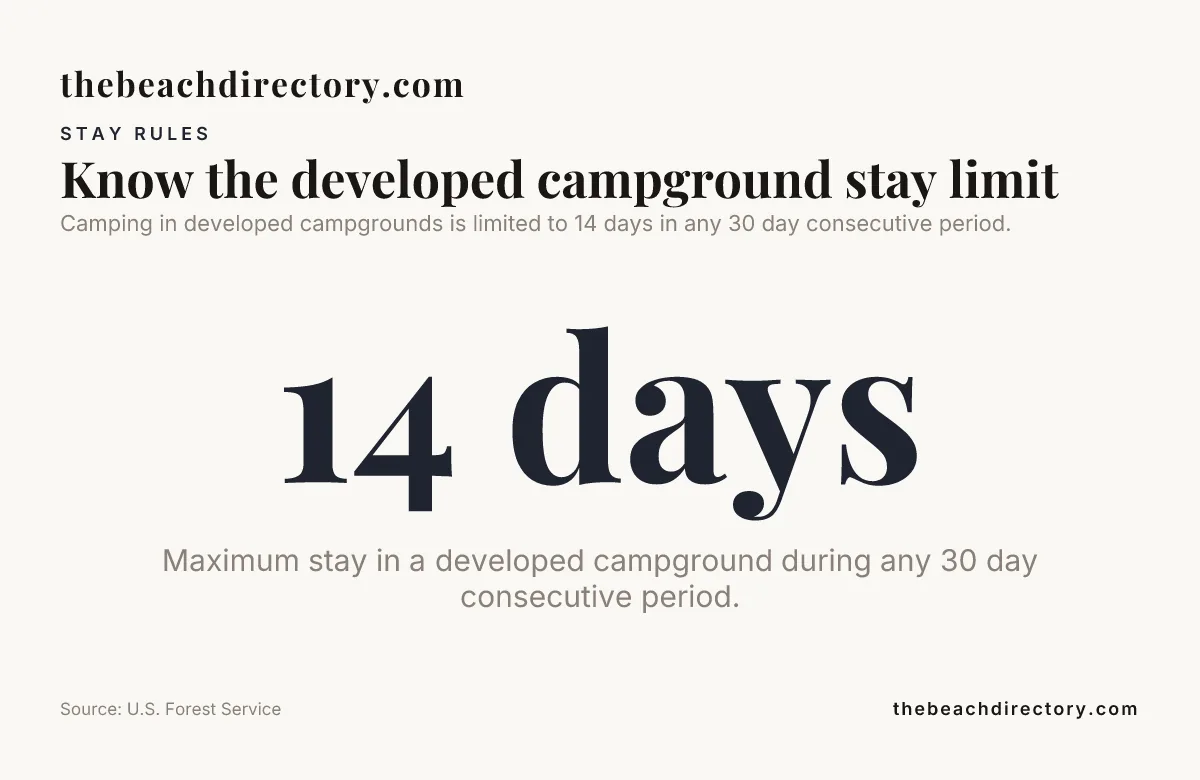
Camping in developed campgrounds is limited to 14 days in any 30 day consecutive period.
Source: U.S. Forest Service
Review changes, check-in, checkout, and alerts
Read the reservation terms before paying, especially the rules for changes, cancellations, arrival, and departure. State and county campgrounds may have different procedures, so follow the terms attached to your reservation.
Yes, campers generally need to check out by the campground’s posted time. Follow the time and departure steps in your confirmation or campground rules, and leave by the permitted checkout time even if the site is empty.
Before leaving, check for temporary closures, weather notices, facility changes, and beach-access restrictions on the official campground or land manager page. If you need to change or cancel, use the reservation system or contact listed by the operator, and review any deadline or fee that applies to your booking.
Step-by-step field checklist for Oregon Coast camping
- Choose the beach area. Decide whether you want a sandy beach, tidepools, dunes, trails, or a protected cove.
- Identify the land manager. Determine whether the campground is state, county, federal, or privately operated.
- Confirm the overnight location. Book a designated campground unless the responsible manager expressly permits camping somewhere else.
- Read the campground rules. Check seasonal operation, fires, pets, quiet hours, vehicle limits, and beach-access conditions.
- Match your site to your group. Verify capacity, tent or RV allowance, driveway length, hookups, and accessibility.
- Book through the correct system. Review the calendar, reservation terms, payment details, and check-in instructions.
- Prepare a backup plan. Identify another campground or date in case your first choice is full.
- Recheck before departure. Look for closures, alerts, and changed access information, then save your confirmation and arrival details.
Frequently Asked Questions
Can I set up a tent on an Oregon beach if the campground is full?
No. Choose another campground or date, and camp only where the land manager allows overnight stays.
Are campfires allowed at Oregon Coast campsites?
Fire rules can change with location, weather, and temporary restrictions. Use only permitted fire areas and follow the current directions from the campground operator, including rules for beach fires.
Can I bring my dog to a coastal campground and beach?
Pet rules depend on the campground and the beach access area. Review leash, cleanup, and restricted-area requirements for both places, since permission at the campsite does not automatically set the rules on the shore.
Will a coastal campground have drinking water and showers?
Facilities vary by campground and season. Check the specific site’s amenities and operating notices, then plan to bring drinking water if the campground does not provide it or a service is temporarily unavailable.
What should I pack to protect a tent from coastal weather?
Bring a rainfly, a groundsheet sized to stay beneath the tent, sturdy stakes, and extra tie-downs for wind. Pack dry clothing and store food and bedding in weather-resistant bags to help manage damp conditions.
What if beach access is closed after I arrive at the campground?
Follow posted closures and do not enter a restricted route. Ask the campground operator about another open access point, then check that route’s conditions and parking before setting out.
See also: thebeachdirectory.com, Best Surf Boards.
Conclusion
Oregon Coast Camping Beaches: Check Rules and Reservation Needs begins with two checks: where overnight camping is allowed and who manages the campground. Once you know those details, compare reservation options, site capacity, vehicle fit, facilities, and beach access before booking.
Use the campground’s current rules for changes, check-in and checkout, walk-up availability, and temporary restrictions. With a suitable site and a backup plan, you can enjoy beach access and coastal activities while following the rules that protect each destination.
Download the Companion Printable Reference Sheet (PDF)
Save or print our one-stop reference sheet for this guide: Oregon Coast Campground Reservation Window, Hookup, and Beach Access Comparison Sheet. Includes the full specification comparison matrix and step-by-step field checklist.